
In partnership with


In Today’s Issue:
🤑 Meta cuts jobs while reorganizing around AI
💵 Anthropic nears a first profitable quarter
📈 Anthropic’s SpaceX compute bill hits $15B-a-year scale
📉 OpenAI’s math result raises the bar for AI scientific work
✨ And more AI goodness…
⚡ The Signal
Today’s issue starts with a hopeful signal: AI is beginning to contribute to real scientific discovery, not just faster software or better chat.
OpenAI says a general-purpose reasoning model helped disprove a long-running Erdős unit-distance conjecture, with external mathematicians reviewing the result. On the business side, Anthropic is reportedly on track for its first operating profit, while Axios says it is also paying SpaceX $1.25 billion a month for compute through May 2029. Add Meta’s AI-driven restructuring, and the pattern is pretty clear: the next phase of AI is not just about smarter models. It is about proof, power, capital, and who gets reorganized around the machine.
All the best,

Kim Isenberg


🧑💻 Meta’s AI Reorg Comes for the Org Chart
Meta has begun cutting roughly 8,000 jobs as it reorganizes around AI-first work. The seeded WSJ story frames the layoffs as part of the company’s AI transformation, while other reports say about 7,000 employees are being moved toward AI-focused roles.
👉 tl;dr: AI is no longer just a product line at Meta. It is changing headcount, reporting lines, and the work Meta expects people to do.

💰 Anthropic’s Profit Moment Comes With a Compute Caveat
Anthropic has reportedly told investors it expects its first operating profit in Q2. TechCrunch, citing the seeded WSJ report, says revenue is projected to more than double to around $10.9 billion. The catch is that this is still a projection for the quarter ending in June, and the company’s compute commitments remain enormous.
👉 tl;dr: Claude’s demand curve is strong enough to create a profitability story. The durability of that story still depends on compute costs.

🚀 Anthropic’s Compute Bill Is Now a SpaceX-Sized Number
Axios reports Anthropic is paying SpaceX $1.25 billion per month through May 2029 for compute capacity. That is a $15 billion-a-year bill, and it explains why compute access is becoming as strategically important as model quality.
👉 tl;dr: The model race is becoming a balance-sheet race. If you cannot secure enough power, chips, and data-center capacity, demand becomes a bottleneck instead of a win.


Ask your AI assistant to separate any breakthrough claim into three layers: what was demonstrated, who verified it, and what still depends on interpretation.
Why it helps: Today’s OpenAI math story is impressive precisely because the claim is checkable, externally reviewed, and bounded. That is the habit worth stealing: do not just ask whether an AI result sounds big; ask what kind of evidence would make it survive contact with experts.
Try this: Paste a technical announcement and ask: "Split this into the core result, the validation process, the strongest limitation, and the second-order implications for the field. Flag any claim that sounds stronger than the evidence supports."


🎬 Watch This
Sam Altman and Patrick Collison discuss the rapid evolution of artificial intelligence, focusing on the recent performance inflection in coding models. They explore the shifting paradigms of software development, the infrastructure requirements for building large-scale intelligence, and how leaders can effectively integrate these transformative tools into their organizations.


"A milestone in AI mathematics"
– Tim Gowers, quoted in OpenAI’s discrete-geometry announcement


The day’s privacy dustup comes from a new lawsuit accusing OpenAI of disclosing ChatGPT query-related information to Meta and Google through tracking code on ChatGPT.com. MediaPost reports that the complaint, filed in federal court in Southern California, claims the alleged disclosures involved sensitive user queries and invokes federal and California wiretap/privacy theories. The case is only an allegation at this stage, but it is a reminder that AI trust is not just about model behavior. It is also about the web plumbing around the product.


OpenAI’s Math Result Is a New Kind of AI Breakthrough
The Takeaway
👉 OpenAI says an internal general-purpose reasoning model disproved a long-standing conjecture in the planar unit distance problem.
👉 The result was checked by external mathematicians and came from algebraic number theory, not a math-only system built for this specific problem.
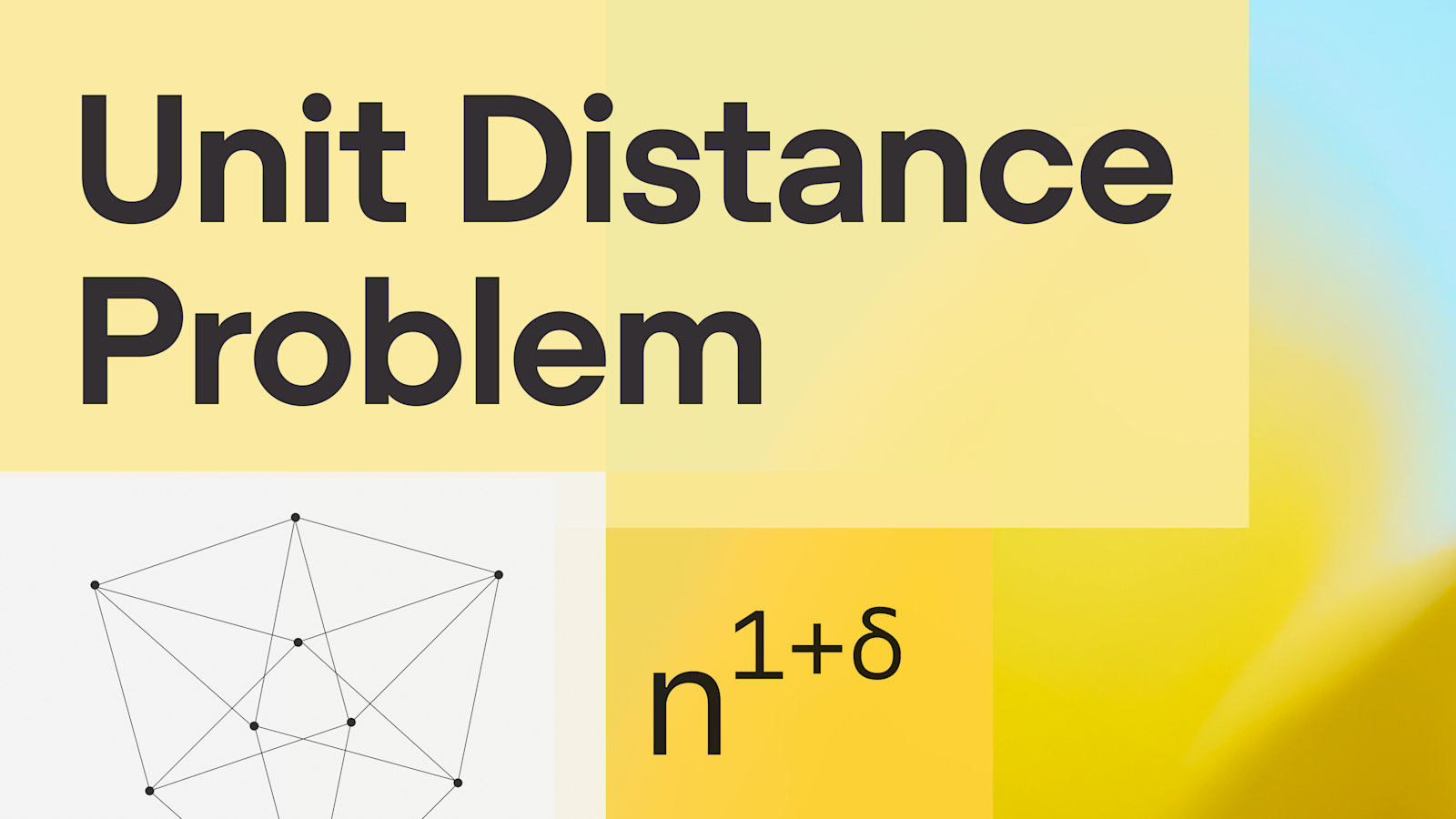
👉 The proof constructs point configurations with at least n^(1+δ) unit-distance pairs for infinitely many n, breaking the old square-grid intuition.
👉 The real story is not "AI replaces mathematicians." It is that AI may now generate research paths experts can verify, refine, and build on.
OpenAI’s new research result matters because the problem is simple to state and hard to move. The planar unit distance problem asks how many pairs of points can be exactly one unit apart when n points are placed in the plane. For decades, the prevailing belief was that square-grid-style constructions were essentially optimal; OpenAI says its model found an infinite family of counterexamples that improves the lower bound by a fixed polynomial factor.

The important detail is how the result was found and checked. OpenAI says the proof came from a general-purpose reasoning model, not a system trained only for mathematics or targeted at this conjecture. External mathematicians reviewed the result, and the companion discussion emphasizes that the model imported sophisticated algebraic number theory into an elementary-looking geometry question.
That makes this different from a demo, benchmark, or clever coding task. Mathematics is unforgiving: a proof either survives inspection or it does not. If AI systems can now surface original constructions that experts can validate and simplify, the frontier of research may start to look more like human-AI search followed by rigorous human interpretation.
Why it matters: This is a clean test of AI as a scientific collaborator because the claim is technical, checkable, and conse=quential inside a real field. The next question is how often models can produce work that survives expert review, not whether they can sound plausible.
Sources:
🔗 https://openai.com/index/model-disproves-discrete-geometry-conjecture/
🔗 https://cdn.openai.com/pdf/74c24085-19b0-4534-9c90-465b8e29ad73/unit-distance-proof.pdf
🔗 https://cdn.openai.com/pdf/74c24085-19b0-4534-9c90-465b8e29ad73/unit-distance-remarks.pdf


The IT strategy every team needs for 2026

2026 will redefine IT as a strategic driver of global growth. Automation, AI-driven support, unified platforms, and zero-trust security are becoming standard, especially for distributed teams. This toolkit helps IT and HR leaders assess readiness, define goals, and build a scalable, audit-ready IT strategy for the year ahead. Learn what’s changing and how to prepare.


The chart: Qwen 3.7 Max benchmarks released.
The lesson: The benchmark shows Alibaba’s Qwen line pushing deeper into the frontier-model conversation, especially around agentic and reasoning-heavy work. The interesting part is not one isolated score; it is the release cadence. Chinese labs are iterating quickly enough to keep real pressure on the U.S. frontier labs.
The caveat: Treat this as a directional leaderboard snapshot, not a final ranking. Benchmark coverage for fresh model releases is uneven, vendors choose what to publish first, and real workflow performance can diverge from launch charts.


A Metabolic Switch May Help Aging Muscles Repair Themselves
⚡ Bottom line: Scientists report that restoring glutaminase activity helped aged muscle stem cells regain regenerative function in mouse models.
💡 Why it matters: Muscle loss is one of the most practical problems in aging: it affects mobility, falls, independence, and recovery from injury.
🔎 What it means: The longevity opportunity is moving from vague anti-aging language toward specific cellular failure modes that can be measured, tested, and potentially targeted.
A new Nature Aging study, covered by Medical Xpress, focuses on muscle stem cells: the repair cells that help maintain and regenerate muscle tissue. The researchers found that aged muscle stem cells have about 50% less glutaminase, weakening their ability to use glutamine metabolism for growth and repair.

The key finding is that restoring GLS1, the missing metabolic component, appeared to revive older cells’ ability to grow and regenerate larger, stronger muscle in mouse models. That is a long way from a human therapy, but it gives researchers a more precise target than simply saying aging muscles "wear out."

The caution is important. Medical Xpress notes that most results so far come from mouse models, and researchers still need to show whether the same pathway matters in human stem cells. But as a longevity signal, the story is useful: rejuvenation increasingly looks like restoring specific cell programs, not finding one universal anti-aging switch.

Get two hours of your day back.
Lindy texts you a meeting brief before every call: who you're meeting, what you discussed last time, what's still open. 1 minute setup. Try it free.